I still remember the first time I asked my class to write an informative essay and realized just how many different reactions one assignment could create.
A few students jumped right in, pencils moving fast. Some stared at the paper, unsure where to begin. Others raised their hands within minutes asking questions like, “How long does it have to be?” or “What am I supposed to write first?”
That moment was a turning point for me.
It wasn’t that my students didn’t understand the topic. They didn’t understand the structure of informative essay writing. Once I shifted my focus from the final product to the process, everything changed.
Informative essay writing stopped feeling intimidating and started feeling manageable. Students knew what to do, where to go next, and how to explain their ideas clearly.
This post shares how I support elementary students with informative essay writing…
By building structure, confidence, and clarity without overwhelm!
Why Informative Essay Writing Feels CHALLENGING
Informative essay writing asks students to juggle several skills at once. They must understand a topic, organize information, explain ideas clearly, and stay focused on one main idea from beginning to end.
That is a lot for young kids.
Most struggles with informative essay writing are not about ability. They are about organization. When students are unsure how to start or how ideas fit together, writing quickly becomes frustrating.
Once a clear structure is in place, students are able to focus on what they want to say instead of worrying about how to say it.
This clear structure includes:
- A clear purpose for writing
- Step-by-step guidance they could follow
- Visual reminders of expectations
- Sentence-level support
Informative essay writing works best when it is taught as a process, not a one-time assignment.

How to Teach Informative Essay Writing Step by Step
Instead of handing students a prompt and hoping for the best, breaking informative essay writing into small, repeatable steps gives students clarity and confidence.
Step 1: Use Clear prompts
Clear prompts:
- Focus on one topic
- Ask students to explain or teach
- Use student-friendly language
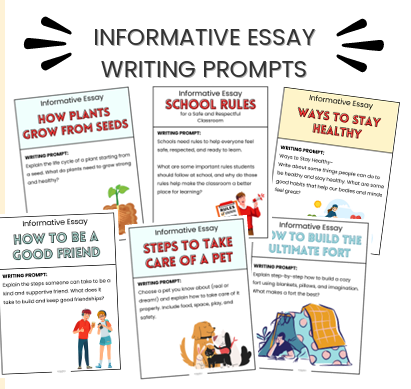
Prompts like explaining how to build a fort work well because students already understand the topic. Their energy goes into explaining clearly, not figuring out what the assignment wants.
This is why I rely on scaffolded informative essay writing prompts that clearly define the topic and purpose before students ever begin writing. When prompts are broken down from the start, students enter the writing process with confidence instead of hesitation.
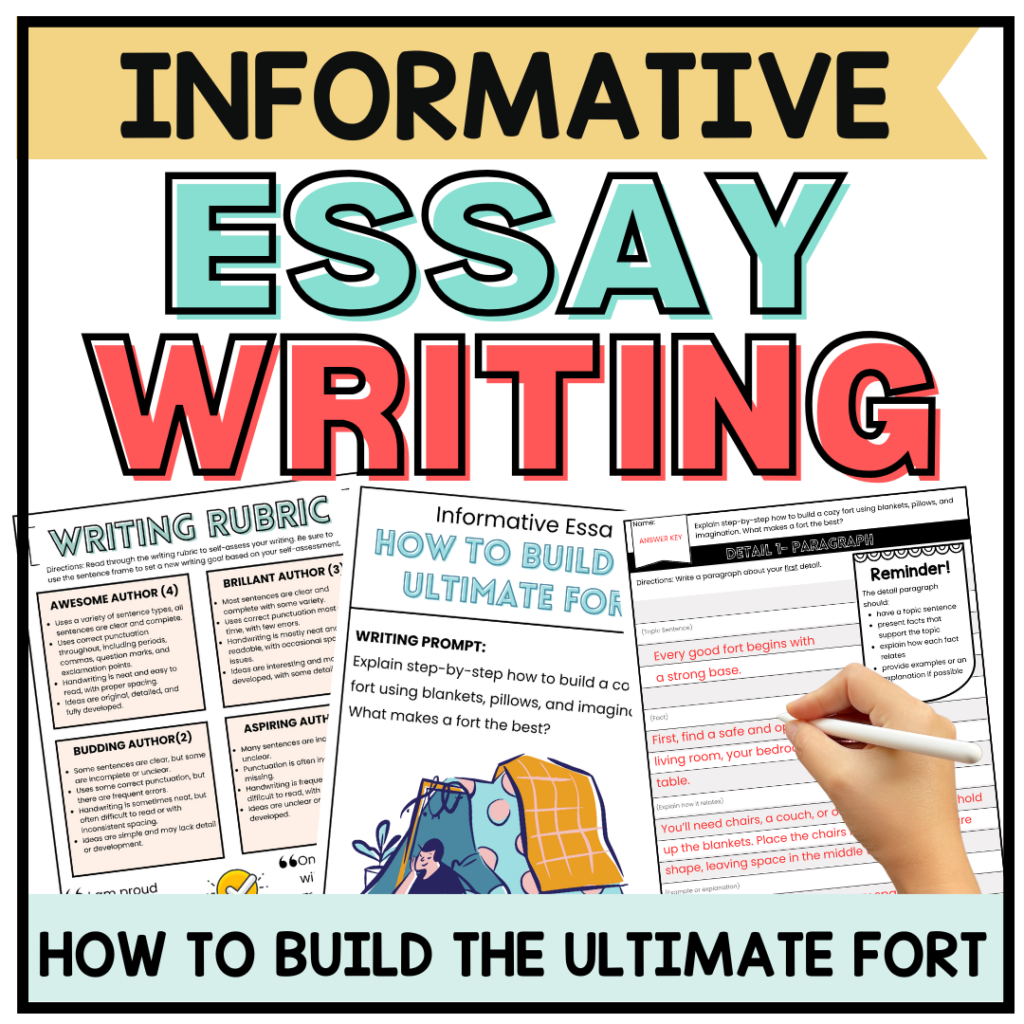
The prompts I use most often come from this Informative Essay Writing Prompts pack because it gives students a clear starting point without overwhelming them:
Step 2: Teach the Structure of Informative Essay Writing First
Before students write a single sentence, they need to understand how informative essays are organized.
I explicitly teach that informative essay writing includes:
- An introduction that explains the topic
- A clear topic sentence
- Supporting details that explain the idea
- Transitions that connect ideas
- A conclusion that wraps everything up without adding new information
When students see these parts broken apart, writing feels manageable. They stop guessing what comes next.
Using consistent organizers and layouts, like the ones included in my informative essay writing materials, helps reinforce expectations without reteaching them every time.
If you’re looking for a simple way to keep informative essay writing organized across lessons, I also share additional writing supports and ideas here that walk through the process in a clear, manageable way.
Step 3: Build Confidence With Sentence Support and Clear Expectations
Sentence-level support plays a huge role in successful informative essay writing, especially for young writers who know what they want to say but are unsure how to start.
Sentence starters, examples, and modeled responses give students a clear way in. Once students begin writing, confidence builds quickly. This type of support removes the fear of getting started and allows students to focus on explaining ideas instead of worrying about wording.
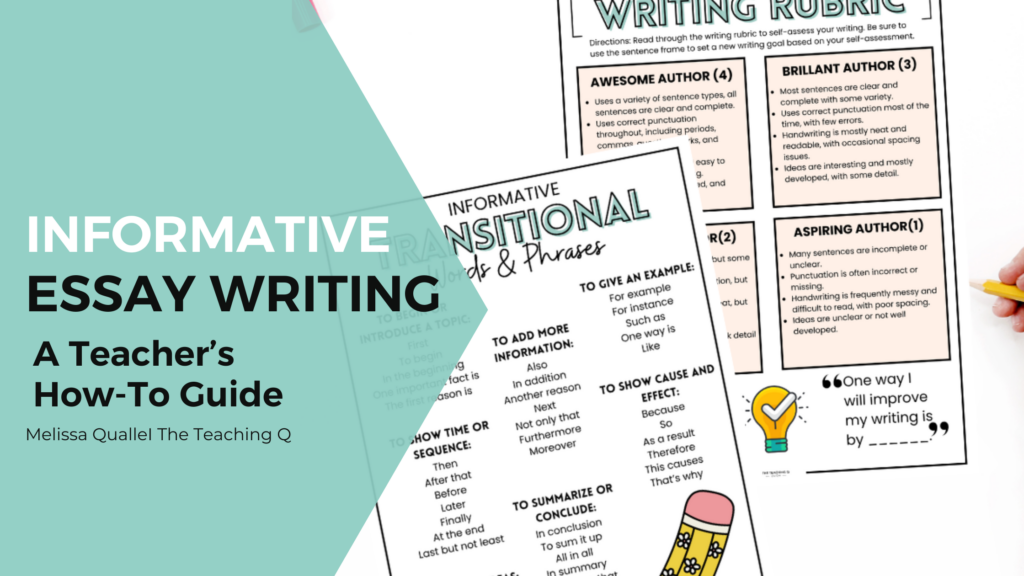
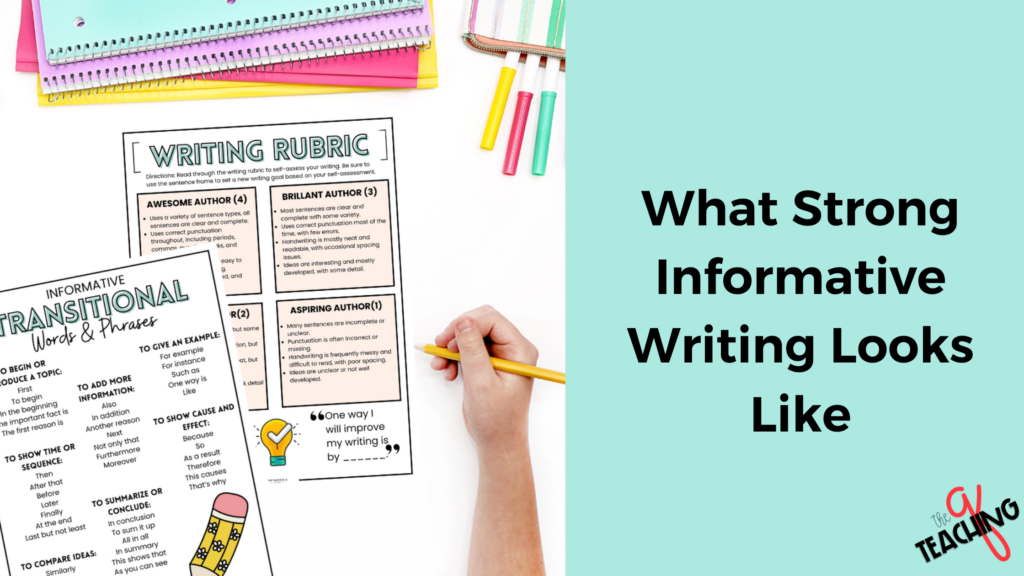
At the same time, students need to understand what strong informative writing looks like and how ideas should flow. This is where a writing rubric and transition word page become especially helpful. The rubric gives students clear expectations for each part of their essay, while the transition word list supports them in connecting sentences and ideas smoothly rather than writing in short, disconnected pieces.
When students can use sentence starters to begin writing, reference a rubric to self-check their work, and choose transition words intentionally, informative essay writing feels structured and purposeful. These supports work together to build confidence while encouraging independence throughout the writing process.
Step 4: Strengthen Writing With Clear Details
Once students are writing with more confidence, the next focus is on detail development.
In informative essay writing, details should do more than fill space. They should explain the topic in a way the reader can understand.
I teach students to slow down and ask:
- Does this detail help the reader learn something?
- Does it explain my topic clearly?
- Does it belong in this paragraph?
Modeling this thinking helps students move beyond listing facts and begin explaining ideas with purpose.
This is where structured pages that guide students through adding details become especially helpful. Students learn how to expand ideas step by step instead of writing everything at once.
Step 5: Support Organization
Organization is often the final piece that pulls informative essay writing together.
Even when students write strong sentences and include good details, their writing can feel scattered without structure. Graphic organizers, checklists, and consistent layouts help students see how each part of their essay connects.
When students know where their introduction, details, and conclusion belong, writing feels calmer and more controlled.
Over time, students internalize this structure and rely on it independently.
Resources to Supports Informative Essay Writing Without Overwhelm
As students move through each step of informative essay writing, having consistent tools in place makes a noticeable difference. When prompts, organizers, sentence supports, rubrics, and checklists all work together, students stop guessing and start writing with intention.
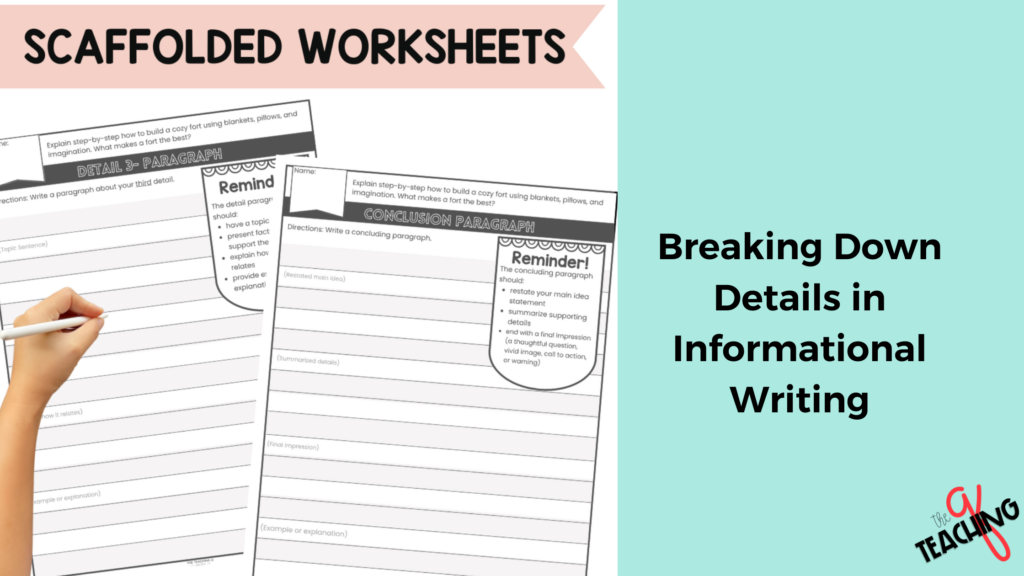
The Informative Essay Writing Prompts with Scaffolded Worksheets were created to support this kind of structured instruction. Each page focuses on a specific part of the writing process so students can concentrate on one skill at a time. Instead of trying to manage everything at once, they work through informative essay writing in a clear, predictable way.
This approach mirrors how I teach other writing skills as well, including summary writing. If you’re building those foundational skills alongside informative writing, I’ve shared more about that process here!
Create a Consistent System
One of the most effective shifts in my writing instruction was moving away from treating informative essay writing as a single assignment and instead teaching it as a reliable routine students could return to again and again.
When writing expectations change from task to task, students spend more time figuring out what to do than actually writing. A consistent system removes that friction. Students recognize familiar steps, tools, and language each time they write, which helps them approach new topics with confidence.
Creating a system for informative essay writing means students work within a predictable process. Clear prompts establish the purpose, organizers guide planning, sentence support helps students explain ideas clearly, and rubrics and transition words provide direction as they draft. Simple checklists encourage students to pause, reflect, and revise as they go.
What makes this system especially powerful is that it extends beyond one type of writing. When students move from informative essay writing into opinion or narrative writing, the expectations feel familiar instead of new. This is why I rely on a larger framework like the Informative, Opinion, and Narrative Essay Writing Mega Bundle, where the same structure and language carry across genres and reduce the need for constant reteaching.
As students grow more comfortable with this process, their independence increases. They begin to reference tools on their own, make purposeful revisions, and explain their ideas more clearly. Writing becomes less about completing an assignment and more about communicating thinking in a meaningful way.