Summary writing is one of those skills that quietly reveals everything about a student’s understanding.
When a student can write a strong summary, you know they understood the text. When they struggle, it usually isn’t because they didn’t read. It’s because they don’t yet know how to decide what information matters most, especially when working with nonfiction text.
That’s why teaching students to summarize is so important. Summary writing sits at the intersection of reading comprehension, critical thinking, and informational writing. It’s not an extra skill. It’s a foundational one students use across content areas.
In this post, I’m breaking down what a summary really is, why summary writing is especially important for nonfiction, and how to teach it in a way that feels clear, purposeful, and manageable.
What Does It Mean to Summarize Nonfiction Text?
Before students can write a summary, they need a definition they can actually use.
A summary is a short piece of writing that explains the most important ideas from a text using your own words.
When working with nonfiction, a summary focuses on:
- The main topic
- Key facts or ideas that explain the topic
- Information that helps the reader understand what the text is mostly about
A strong nonfiction summary:
- Includes the main idea
- Includes only the most important facts
- Is shorter than the original text
- Uses the student’s own wording
This is different from a retelling, which often includes many facts or follows the order of the text closely. Nonfiction summaries require students to filter information, not list it.
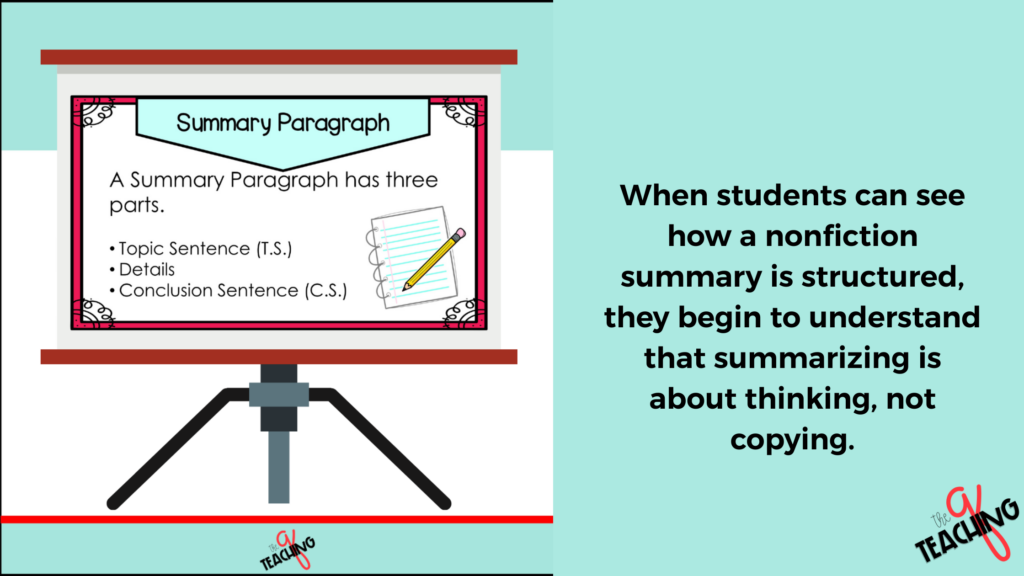
Why Teaching Students to Summarize Nonfiction Matters
Nonfiction texts are packed with information. Without explicit instruction, students often feel overwhelmed by facts and details.
Teaching students to summarize nonfiction helps them:
Identify key information
Students learn to distinguish between important facts and interesting but unnecessary details.
Build informational writing skills
Nonfiction summaries strengthen topic sentences, fact-based details, and clear conclusions.
Improve comprehension across subjects
Summarizing supports learning in science, social studies, and content-area reading.
Gain confidence with complex texts
Students feel more capable when they know how to break information down.
Summary writing also supports paragraph writing and idea development. If you’re helping students organize their thinking in longer responses, How to Inspire Creativity in Elementary Students with Paragraph Writing Prompts pairs well with nonfiction summarizing because it reinforces clarity and structure.
A Simple Way to Introduce Nonfiction Summary Writing
Nonfiction summary writing works best when students are taught a clear process.
Start with this idea:
A nonfiction summary explains the main topic and the most important facts, nothing more.
Guide students through questions like:
- What is this text mostly about?
- Which facts help explain the topic?
- Which details can be left out?
One rule I always emphasize:
If a fact does not help explain the main topic, it does not belong in the summary.
Common Challenges with Nonfiction Summaries
Nonfiction summaries come with their own challenges.
Too many facts
Students often want to include everything they learned. Help them narrow their focus to only the most important ideas.
Copying from the text
This is common with informational text. Encourage students to explain the topic aloud before writing.
Listing instead of explaining
A summary should explain ideas, not list facts. This is where sentence clarity matters.
Strong summaries depend on strong sentences, which is why Building Strong Sentences: A Teacher’s Guide to Writing Complete Sentences supports nonfiction summary writing so well.
Integrating Nonfiction Summaries into Daily Instruction
Nonfiction summary writing should be part of your regular routine.
Some easy ways to integrate it:
- Summarize a science article in two sentences
- Write a short summary after a social studies passage
- Create oral summaries before writing
- Compare summaries to identify key ideas
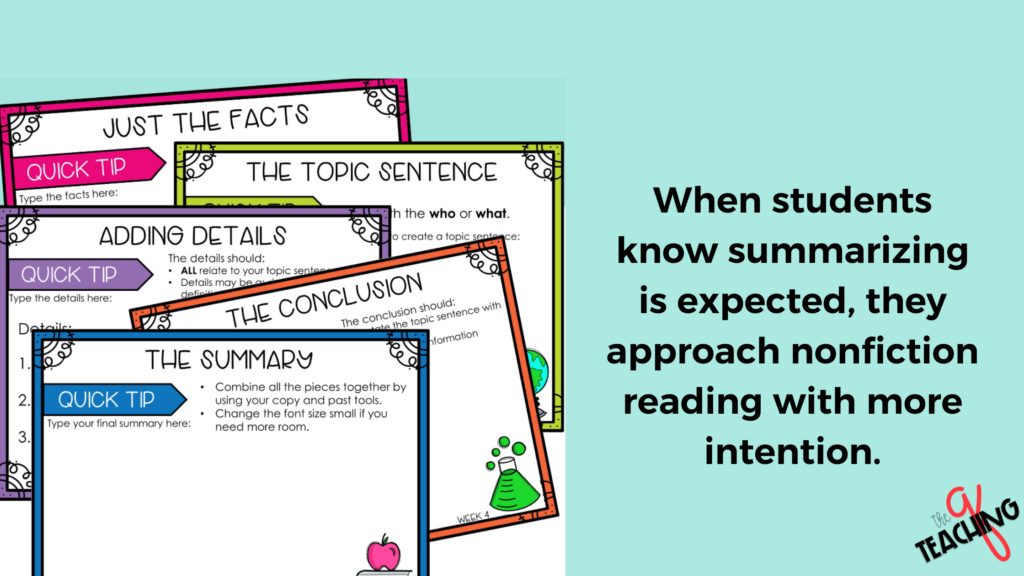
How I Support Nonfiction Summary Writing in My Classroom
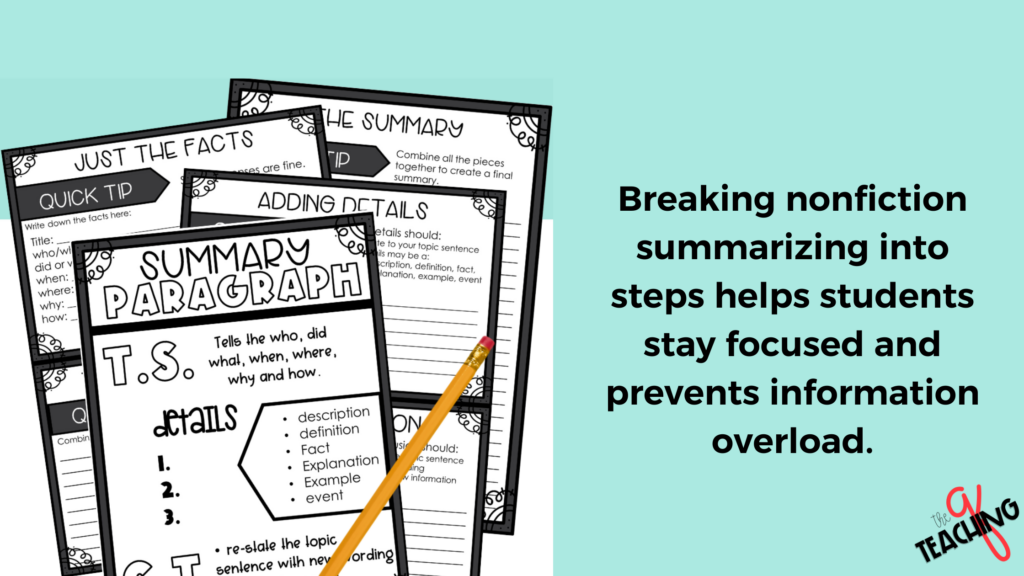
To help students succeed with nonfiction summaries, I use a consistent framework that walks them through the thinking behind summary writing, not just the final product.
The Summarizing Nonfiction PowerPoint Lesson is built as a sequence of clear, teacher-led slides that model each part of the summary process. The slides visually guide students through:
- Identifying the topic of an informational text
- Pulling only key facts that support that topic
- Writing a clear topic sentence in their own words
- Adding supporting details that explain the main idea
- Ending the summary without introducing new information
Because the lesson is presented through structured PowerPoint slides, students can see exactly how a nonfiction summary develops from start to finish. The visuals and examples help clarify expectations and give students a reference they can return to during independent practice.
The slides are designed to support direct instruction, guided practice, and discussion, making them especially useful when introducing or reinforcing nonfiction summary writing. Instead of feeling rushed or overwhelmed, students follow along step by step and gain confidence as they apply the strategy to real informational texts.
You can see that lesson below!
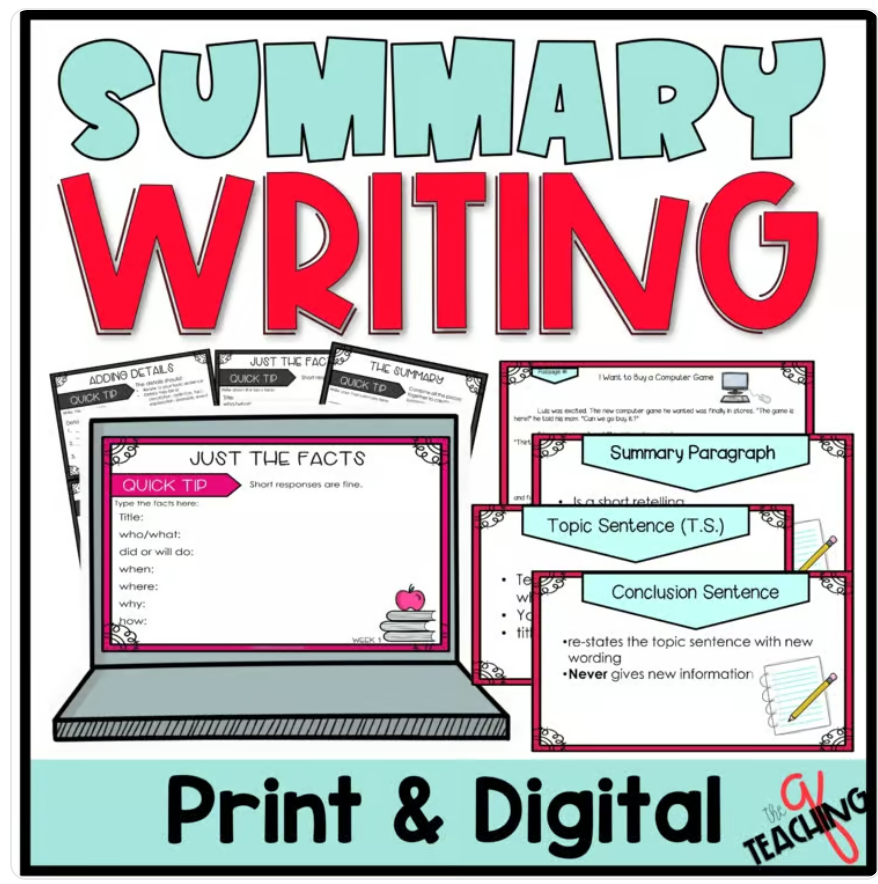
The lesson is designed to support nonfiction reading instruction by breaking summary writing into clear, repeatable steps students can apply across subjects. One thing I’ve learned over time is that students do best when they have a consistent framework they can rely on every time they summarize informational text.
That’s why I often reference the TACO strategy when teaching nonfiction summaries. It gives students a familiar structure for organizing their thinking, so they aren’t guessing how to start or what to include.
If you’d like to learn more about how I use TACO to support summary writing, paragraph structure, and nonfiction responses, you can join my Teaching Q community here:
It’s where I share practical writing strategies, classroom systems, and real examples that help make writing instruction feel more manageable and intentional.
How Nonfiction Summary Writing Strengthens Writing Skills
Once students understand how to summarize nonfiction using a clear structure, their writing improves in noticeable ways.
Students begin to:
- Write clearer topic sentences
- Choose facts intentionally
- Stay focused on one main idea
- Revise with purpose
Nonfiction summaries help students see writing as a way to explain information clearly, not just complete an assignment.
When we take the time to teach students how to summarize, we give them a skill they can carry into every subject area. They learn to slow down, think critically, and communicate ideas with purpose. Summary writing becomes less about getting through a task and more about truly understanding what they read.
With clear instruction, consistent language, and a simple structure students can rely on, summarizing nonfiction texts becomes one of the most powerful tools in your literacy block.
And that’s a skill worth teaching well.
Related Writing Skills That Support Nonfiction Summaries
Summary writing does not exist on its own. When students are learning how to summarize nonfiction texts, they are also relying on other core writing skills.
Two areas that strongly support nonfiction summary writing are paragraph development and sentence structure.
If your students struggle to organize ideas or explain information clearly, these posts may be helpful next steps:
- How to Inspire Creativity in Elementary Students with Paragraph Writing Prompts
This post shares ways to help students organize ideas into clear paragraphs, which directly supports writing strong nonfiction summaries. - Building Strong Sentences: A Teacher’s Guide to Writing Complete Sentences
Strong summaries depend on clear, complete sentences. This post breaks down how to help students improve sentence clarity so their summaries make sense to the reader.
These skills work together. When students can write clear sentences and organize ideas into paragraphs, summary writing becomes much more manageable.