Thinking about helping your students and don’t know where to start with modeling writing? Have you ever looked at a student’s paper and thought: “We literally just talked about this.” Not in a frustrated way, more in a genuinely confused way. You taught the skill; you showed examples.
Students nodded along.
Then writing time started, and suddenly those strong details, transition words, and complete explanations seemed to disappear. I’ve had that happen more times than I can count. For a long time, I thought students simply needed more practice.
What I eventually realized was that many students didn’t need another worksheet or another writing prompt.
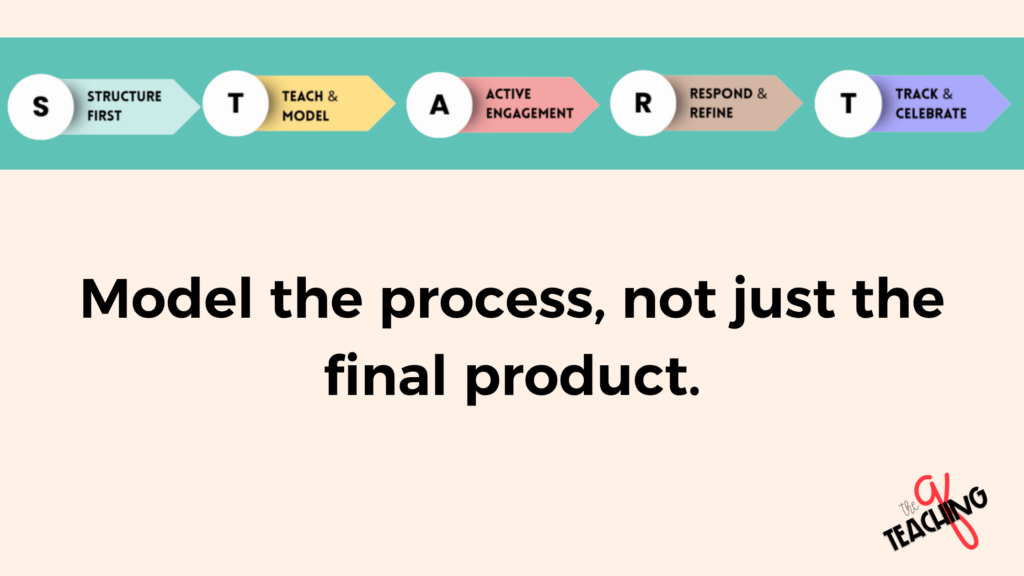
They needed to watch the writing happen. They needed to see how writers make decisions. How writers get stuck, add details, and revise and think! That’s exactly why the “T” in START stands for Teach & Model.
Because telling students what good writing looks like is very different from showing them how it gets created. And honestly, once I started modeling more and talking through my thinking out loud, I noticed students beginning to use those same strategies in their own writing.
Why Modeling Writing for Elementary Students Matters
Think about how we teach almost every other skill. When teaching math, we solve problems in front of students. When teaching reading, we model fluency and comprehension strategies. Also, when teaching science, we often demonstrate an experiment before asking students to try it themselves. Yet with writing, it’s easy to fall into the habit of explaining instead of showing.
We might say:
- Add more details.
- Use transition words.
- Explain your thinking.
- Write a stronger introduction.
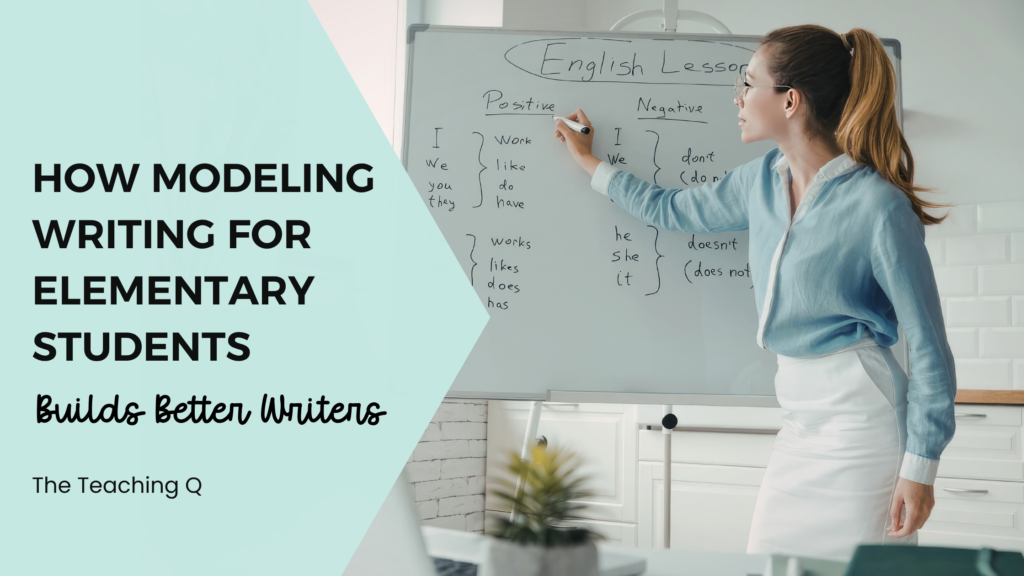
But students often do not know what those directions actually look like in practice. That’s why modeling writing for elementary students is so powerful. It takes the invisible parts of writing and makes them visible. Students get to see the process, not just the final product.
The Difference Between Explaining and Modeling
For years, I thought I was modeling. In reality, I was mostly explaining. There’s a difference, explaining sounds like: “Use a transition word here.” “Add more details,” “make your introduction stronger,” modeling sounds like: “I’m going to add the word first because I want my reader to know this is my first reason.” “This sentence feels too short. Let me add an example.”
“I don’t love this introduction. I’m going to try a different way to start.” Students need to hear those decisions being made. Because writing isn’t just a finished paragraph. It’s a series of choices. And when students hear those choices being made repeatedly, they start making them on their own.
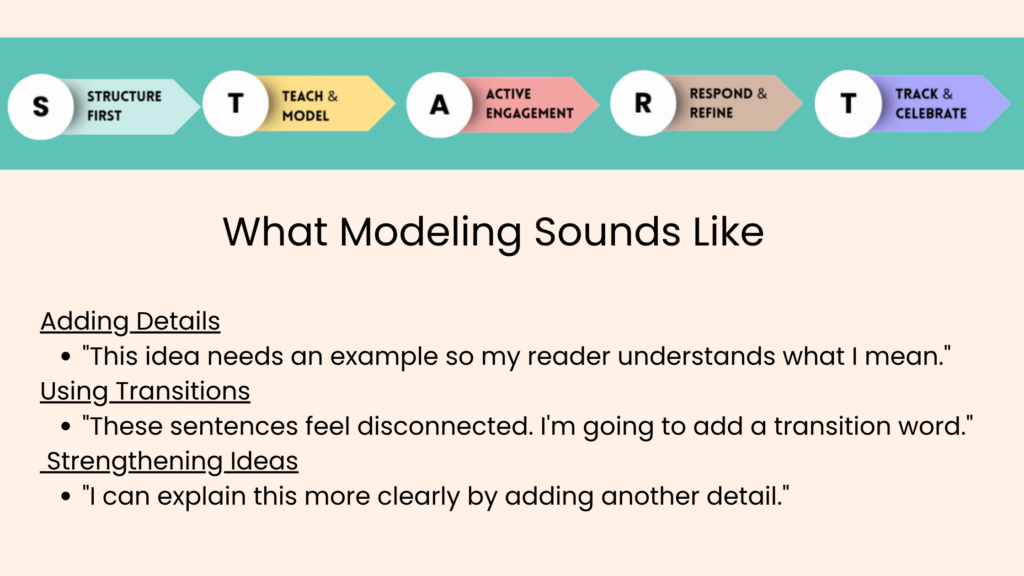
The Think-Alouds I Use Most Often When Modeling Writing
This is exactly why the Teach & Model step is part of the START Writing System. Before students can successfully write independently, they need opportunities to watch writing happen. They need to hear the decisions, questions, and revisions that strong writers make along the way. That’s where modeling becomes so powerful. One of the easiest ways to start modeling is by thinking out loud. You do not need a fancy lesson.
You simply need to let students hear your thinking. In fact, some of my best modeling moments happen when I pause in the middle of writing and simply explain what I’m thinking. Here are a few examples I use often.
When Teaching Introductions
I’ll say: “I don’t want every sentence to start the same way,” or “What would make a reader want to keep reading?” Students begin thinking about introductions as writers instead of filling in a blank.
When Teaching Details
I’ll stop and say: “This sounds too general,” or “Can I give an example here?” Students start noticing that details help readers understand their ideas.
When Teaching Transitions
I’ll say: “These ideas feel disconnected,” or “I need a transition word to connect these thoughts.” Students begin understanding the purpose behind transition words instead of simply adding them because the teacher said so.
When Teaching Conclusions
I often ask: “What do I want my reader to remember?” That one question can completely change the quality of student conclusions. Over time, something really interesting starts happening. Students begin using those same questions on their own. You’ll hear things like: “I think I need another detail.” “This doesn’t sound right yet.” “Maybe I should add a transition here.” That’s when you know the modeling is working. Students are no longer just following directions.
They’re starting to think like writers.
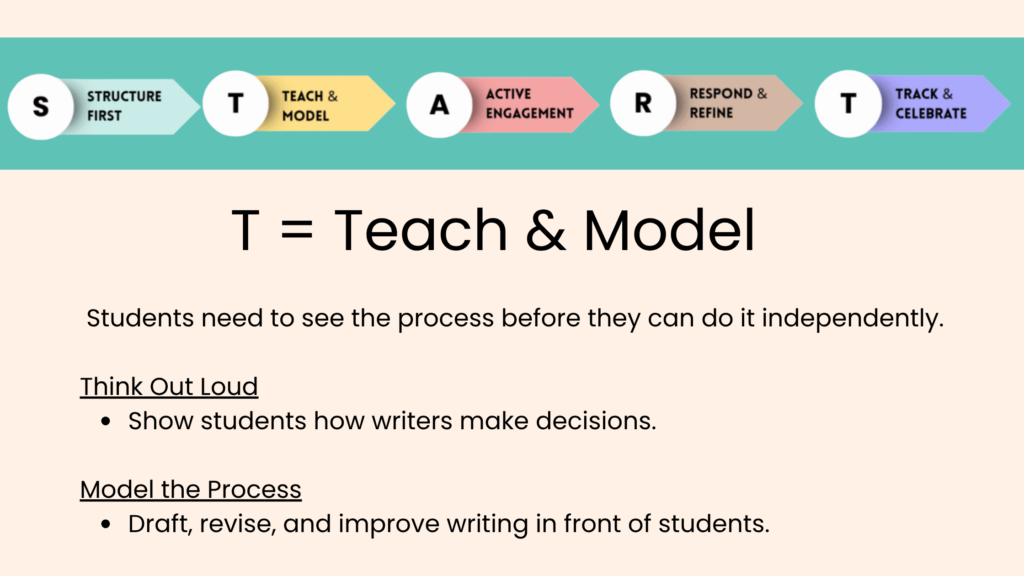
What Students Learn When We Model
Something interesting happens when students watch writing happen in real time. They stop thinking that good writers magically know what to write. Instead, they start seeing that writing is a process. They see writers:
- stop and think
- reread sentences
- change words
- add details
- revise ideas
- improve their work
And honestly, I think that’s one of the most valuable lessons we can teach. A lot of students assume that if writing feels hard, they’re doing it wrong. But when they watch us work through the process, they realize that struggling is part of writing. That’s a powerful shift. Because students become much more willing to keep going when they understand that strong writing isn’t about getting it perfect the first time.
Common Modeling Mistakes Teachers Make
Let’s be honest. Most of us were never formally taught how to model writing. We learned by doing. Because of that, there are a few modeling mistakes I see all the time.
Mistake #1: Showing Only the Final Draft
Students need to see the messy version too. They need to see:
- crossed-out words
- rewritten sentences
- added details
- revisions
That’s where the learning happens.
Mistake #2: Moving Too Fast
When we know exactly what we want to write, it’s easy to rush. Students don’t know what we’re thinking. Slow down; pause often. Talk through your decisions.
Mistake #3: Modeling Once and Moving On
Modeling shouldn’t happen only at the beginning of a unit. I model:
- brainstorming
- introductions
- body paragraphs
- conclusions
- revisions
The more students see the thinking, the more likely they are to use those strategies independently.
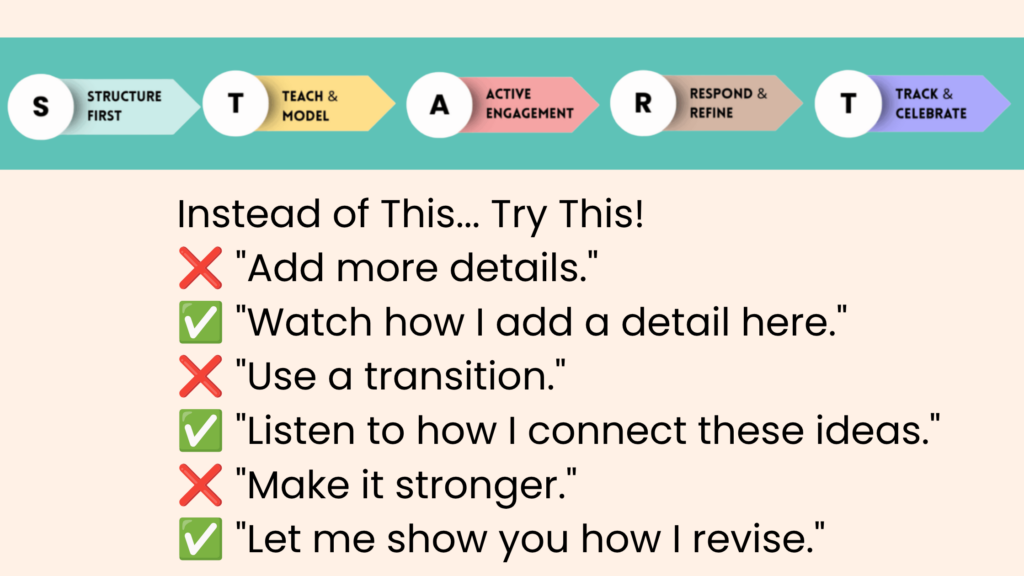
How Teach & Model Fits Into the START Writing System
In the last blog post, we talked about why structure comes first. Students need a roadmap. But having a roadmap and knowing how to follow it are two different things. That’s where Teach & Model comes in. I like to think about it this way: Structure shows students where to go. Modeling shows students how to get there. Students might have:
- graphic organizers
- paragraph outlines
- sentence stems
- transition word lists
But if they’ve never seen those tools used in action, they’re often unsure how to apply them. That’s why Teach & Model comes right after Structure First in the START Writing System. The two pieces work together. Structure creates clarity. Modeling creates confidence.
Want Help Planning What to Model?
One question I hear a lot is: “What exactly should I be modeling?” My answer is always the same: Anything you expect students to do independently. If students are expected to:
- brainstorm
- draft
- revise
- strengthen details
- write conclusions
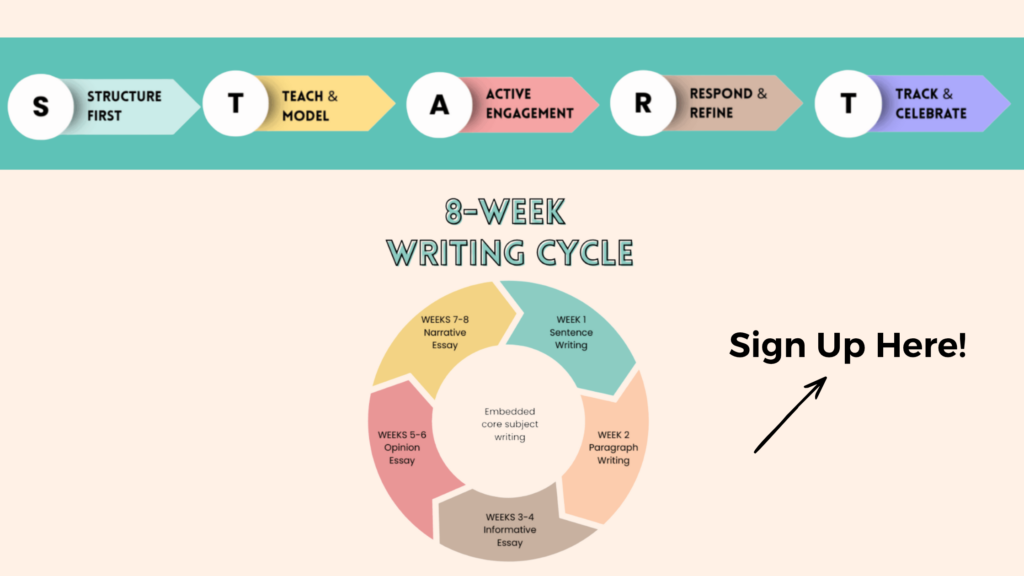
That’s one of the reasons I created the 8-Week Writing Cycle. Teachers often know modeling is important. The challenge is figuring out when to do it and what to focus on. The cycle helps break writing into manageable pieces so students repeatedly see strong writing habits modeled throughout the entire process. Instead of showing students one polished example, they get to watch writing develop step by step.
If you’d like to learn more about the cycle, you can find it here: 8 Week Writing Cycle
Free START Writing System for Elementary Teachers
If you’ve been following along with this series, the free START Writing System is a great next step. It walks through:
- Respond & Refine
- Structure First
- Teach & Model
- Active Engagement
- Track & Celebrate
You can grab the free START Writing System here!
What’s Coming Next in This Series
Next, we’re diving into the A in START:
Active Engagement
We’ll talk about why students need opportunities to discuss, rehearse, and interact with ideas before they ever start writing. Because sometimes the strongest writing happens before a pencil even touches the paper.