Opinion writing is more than having an opinion.
Opinion writing is when students clearly state what they believe and explain why they believe it in a way others can understand.
That sounds simple, but it’s actually a complex skill. Students are asked to think, organize ideas, explain reasoning, and communicate clearly all at once. When any one of those pieces is shaky, the writing falls apart.
That’s why opinion writing doesn’t improve instantly. It grows as students learn how to do each part better over time.
What It Really Asks Students to Do
When students are working on opinion writing, they are learning to:
- Decide what they believe about a topic
- Stay focused on one clear opinion
- Give reasons that connect to that opinion
- Explain ideas so someone else understands their thinking
If any of these skills are missing, opinion writing feels frustrating for students and teachers.
Growing your students’ writing means intentionally teaching and revisiting these skills instead of expecting them to appear all at once.
Why Opinion Writing Needs to Grow Over Time
Opinion writing is not a single skill. It is a combination of skills that develop with practice.
Students don’t struggle because they “don’t get opinion writing.”
They struggle because they are still learning how to:
- organize ideas in writing
- explain thinking with words
- move beyond short answers
Revisiting opinion writing matters because each time students return to it, they practice these same skills again with more understanding than before.
This is how growth happens.
What We Want Students to Learn
When opinion writing instruction is effective, students gradually learn how to:
1. Clearly state an opinion
Students move from vague responses to clear statements of belief.
They begin to understand that opinion writing starts with:
- one idea
- one position
- one clear focus
2. Explain why instead of just answering
Many students can share an opinion but struggle to explain it.
Opinion writing instruction helps students learn how to:
- give reasons
- add details
- explain thinking instead of listing ideas
3. Organize ideas so writing makes sense
Students learn that opinion writing has structure.
Not to sound robotic, but to:
- keep ideas in a logical order
- separate opinions from reasons
- build paragraphs that stay on topic
4. Use language that supports their thinking
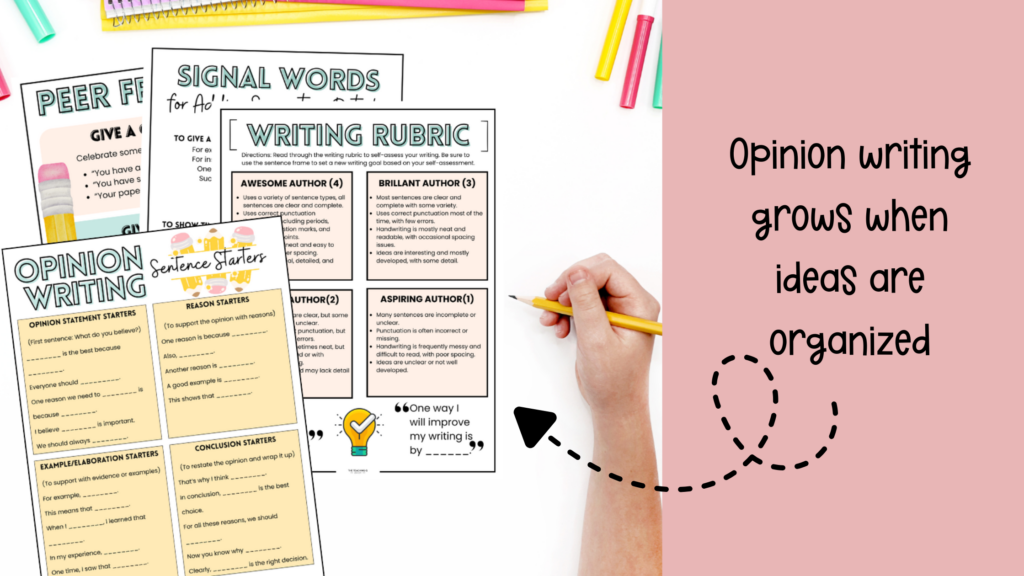
Sentence starters, signal words, and examples help students say more than “I think.”
Over time, students rely on these supports less as their confidence grows.
How Scaffolds Support Growth
Scaffolds exist to support learning, not replace it.
In opinion writing, scaffolds help students do the thinking work that often gets in the way of writing. They reduce the barriers so students can focus on what they believe and how to explain it.
In practice, scaffolds support students by helping them:
- get started when they aren’t sure how to begin
- stay focused on one clear opinion
- explain ideas instead of stopping at short answers
Strong scaffolds don’t tell students what to think. They give students a way to show their thinking.
That’s where the Opinion Essay Writing Prompts and Scaffolded Worksheets Bundle fits in. The bundle is built around the idea that opinion writing support should be flexible, not all-or-nothing.
Inside the bundle, teachers will find:
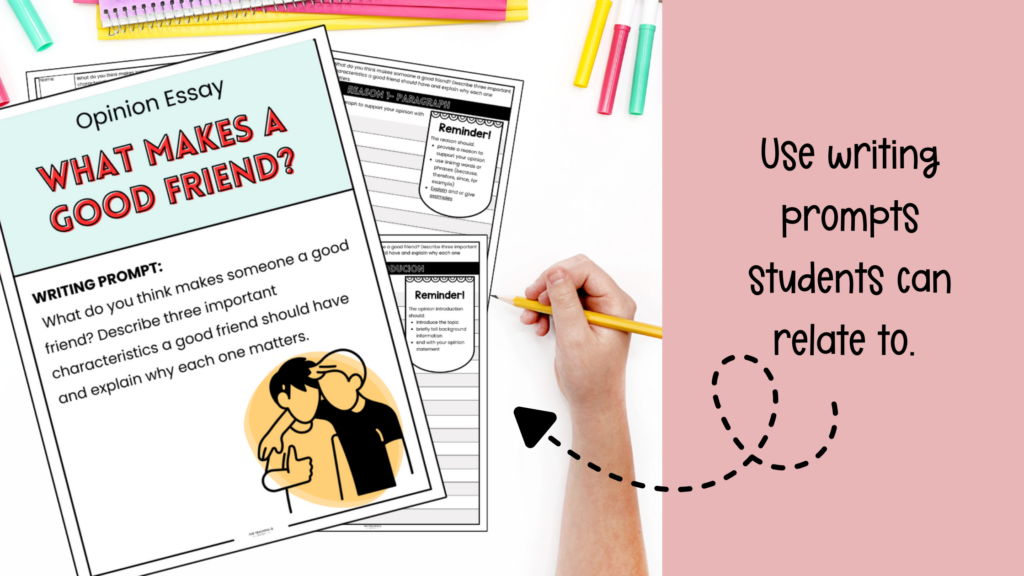
- clear opinion writing prompts that give students something meaningful to respond to
- brainstorming and planning pages that help students organize ideas before writing
- scaffolded writing pages that guide students through introductions, reasons, and conclusions
- optional sentence starters and language supports that students can use as needed
The value of the bundle is not that every student completes every page. The value is choice.
Some students may need full support from start to finish. Others may only need a prompt and a single writing page. Teachers can pull the pieces that make sense for their students and leave the rest.

Why Differentiation Matters in Opinion Writing
Opinion writing highlights differences quickly. Some students need help getting started. Others need support organizing ideas. Some are ready to write independently but still benefit from structure.
That’s why differentiation is especially important in writing. Expecting every student to use the same level of support often leads to frustration instead of growth.
Flexible resources make differentiation more manageable. The Opinion Essay Writing Prompts and Scaffolded Worksheets Bundle is designed so teachers can adjust support without changing the task. Students respond to the same type of prompt, but the level of scaffolding can vary based on need.
Within the bundle, teachers can:
- offer full planning and sentence support to students who need it
- provide lighter structure for students who are ready for more independence
- reuse the same format while adjusting expectations
This allows opinion writing to stay consistent while still meeting students where they are.
If you want to explore differentiation more deeply across your writing block, this connects closely with how I approach flexible support in writing instruction. I share more about that process in my post on how to differentiate writing instruction, especially when students are working at different levels but learning the same skill.
What Teachers Learn When Writing Is Taught Over Time
Teaching opinion writing over time allows teachers to:
- see where students get stuck most often
- adjust support based on real student needs
- reuse structures so students feel confident
- focus on growth instead of perfection
Instead of asking, “Did they write a good essay?”
The focus shifts to, “What part of their writing are they getting better at?”
That shift makes instruction more effective and more manageable.
Why Repetition Builds Stronger Opinion
Revisiting opinion writing doesn’t mean repeating the same lesson.
It means giving students multiple chances to practice:
- stating opinions
- explaining reasons
- organizing ideas
Each time students return to their writing, they bring more experience with them. The work feels more familiar. The expectations feel clearer. The writing feels less intimidating.
This is why larger collections like the Writing Mega Bundle support instruction differently. They allow this writing to show up again and again with new prompts while reinforcing the same core skills.

What Growth in Opinion Writing Actually Looks Like
Growth in writing doesn’t always show up as longer essays or perfectly polished paragraphs.
More often, it looks like this:
- Students state their opinions more clearly
- Explanations feel more thoughtful and complete
- Ideas stay focused instead of jumping around
- Students rely less on support because they understand the process
Growth happens when students know what opinion writing is asking them to do and feel supported as they practice.
Over time, students begin to recognize the structure. They understand how opinions, reasons, and explanations work together. Writing feels less intimidating because the process is familiar.
That kind of growth doesn’t come from one assignment. It comes from seeing writing again and again with clear expectations and consistent support.
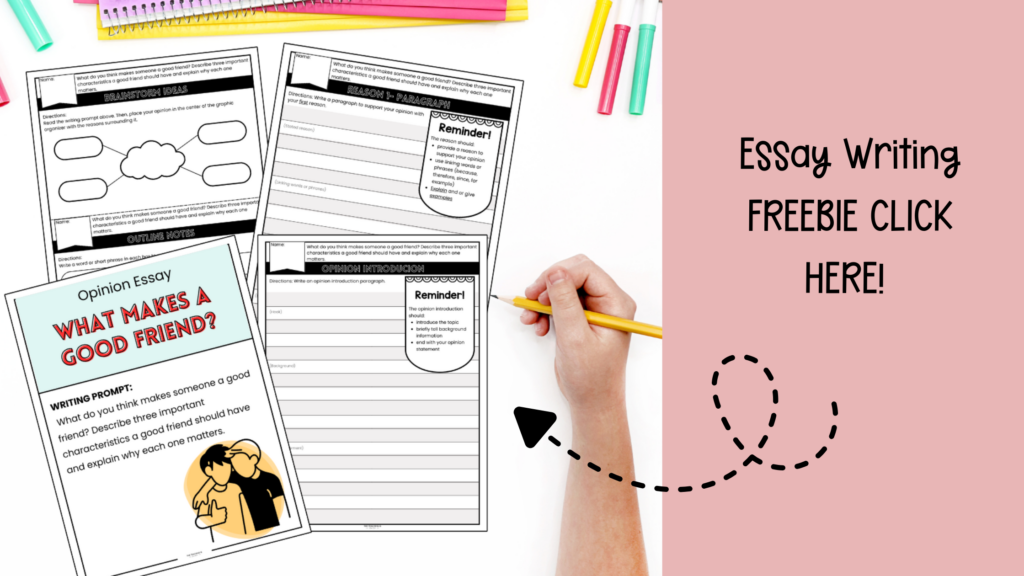
If you want to see a sample of what that kind of support can look like in action, you can grab a free essay writing resource here: