If you’ve ever read a student writing sample and found yourself asking, “Wait… where’s the rest of this sentence?” You’re not alone. Teaching kids to write in complete sentences is a foundational skill, but it doesn’t always come easily.
Between fragments, run-ons, and the occasional word salad, sentence structure can be a tricky concept for young learners to grasp.
But here’s the good news: with the right tools (and a little creativity), you can help students understand what makes a sentence complete and even have fun doing it. Second grade is my jam, and I love helping students feel confident as they build better sentences!
Steps to Building Stronger Complete Sentences
Step One: Introduce Sentence Structure
Before we jump into games or writing prompts, I make sure my students really understand what we mean by “complete sentence.” We talk about the three key parts they’ll see again and again:
- A subject- who or what the sentence is about
- A predicate- what the subject is doing or what’s being said about it
- A complete thought- something that makes sense all on its own
We practice identifying each part with short, simple examples. Sometimes I’ll write a fragment on the board and ask, “Why doesn’t this sound finished?” We’ll brainstorm what’s missing together.
Fragment: Because the cat
Complete Sentence: Because the cat was hungry, she meowed at the door.
Once they’ve got the basics, I also introduce the three main types of sentences they’ll use most often:
- ➡️Simple sentences- “The bird sings.”
- ➡️Compound sentences- “The bird sings, and the wind blows.”
- ➡️Complex sentences- “When the bird sings, the wind blows.”
This is also when I bring in sentence stems. These are just little “starter” phrases that give students the first few words so they can focus on finishing their idea. For example:
- “I noticed that…”
- “One reason is…”
- “When _____happened, I felt….”
Sentence stems take away the fear of staring at a blank page. They’re especially powerful for reluctant writers or English learners who need a little nudge to get started. Over time, the stems fade away, and students start creating complete thoughts independently, but in the beginning, they’re a huge confidence booster.
To learn more about sentence starters, check out my blog post on it here! Sentence Stems in the Classroom
Step Two: Use Visual Tools to Help Students “See” and “Feel” a Complete Sentence
Explaining what a complete sentence is can only go so far; kids need to see and touch the concept. That’s where visual tools and hands-on activities make all the difference.
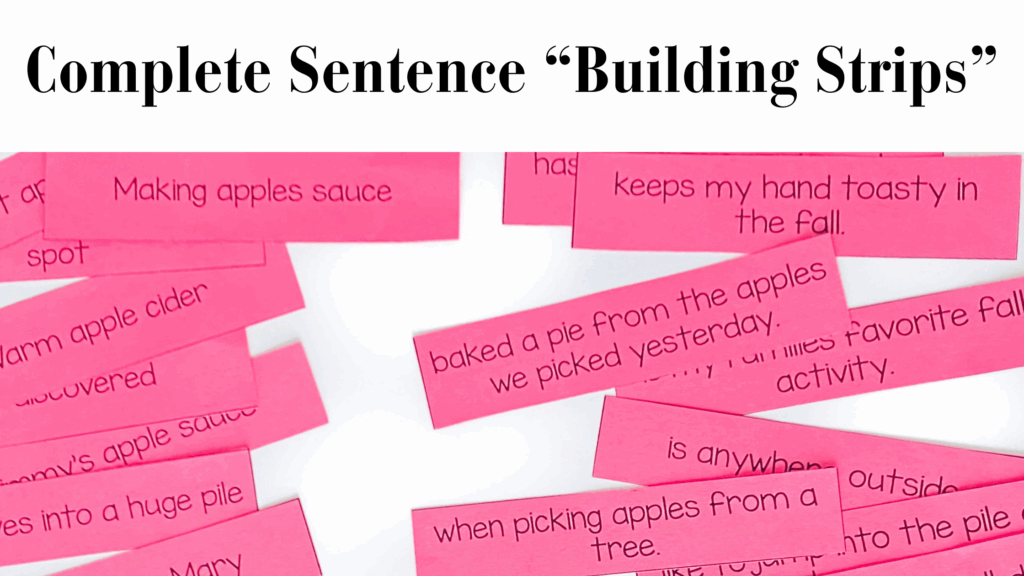
One of my favorites is a set of sentence-building strips. Each strip has a subject, verb, or detail. Students mix and match to create complete sentences. They get to physically hold the pieces and see how moving them around changes the sentence. If something’s missing, it’s immediately obvious.
We also use guiding questions to check our work:
- “Does this make sense by itself?”
- “What is the subject doing?”
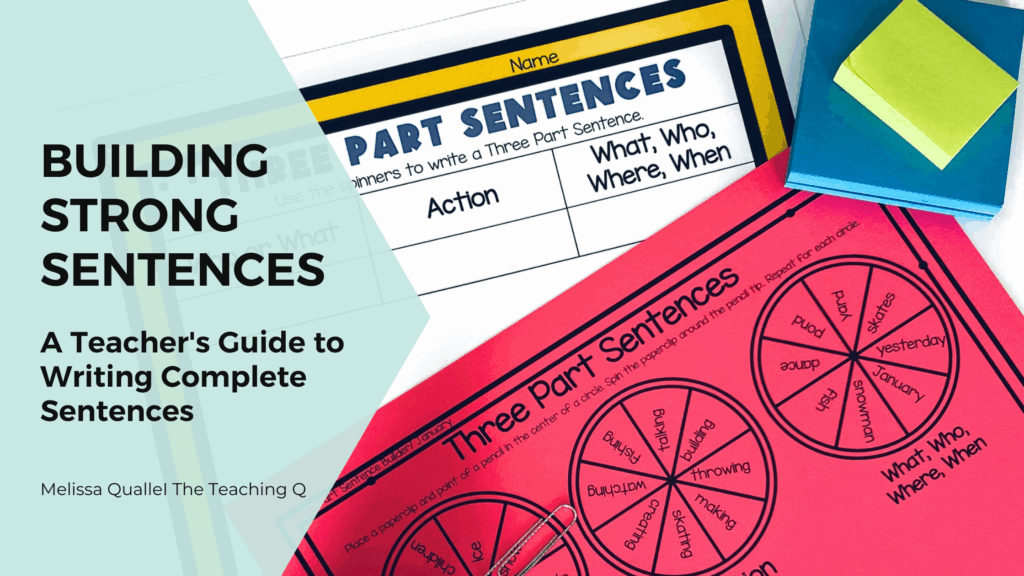
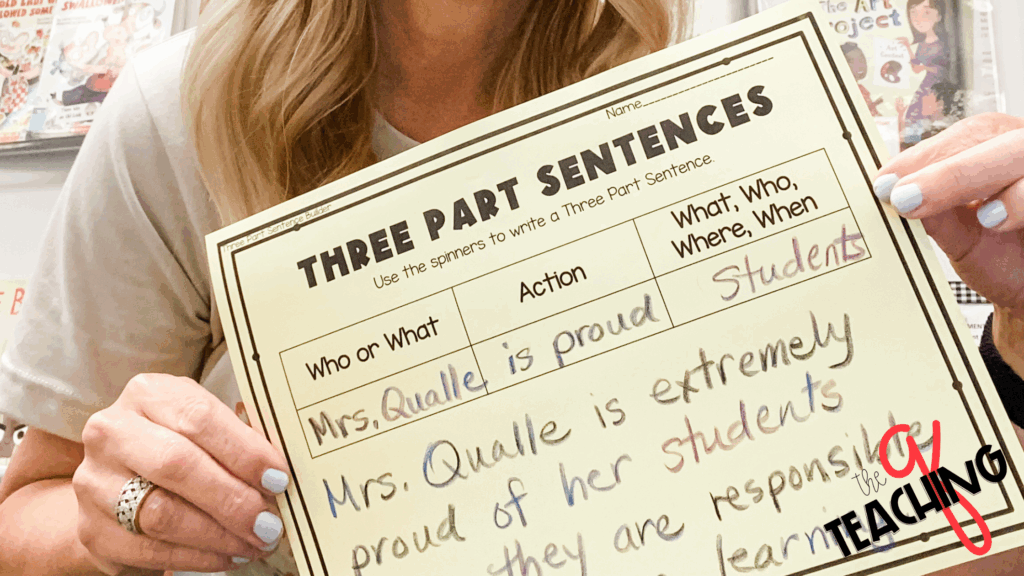
Once students get comfortable with this, we take it up a notch with the Three-Part Sentence Spinner. The spinner adds an element of surprise and play, which students absolutely love.
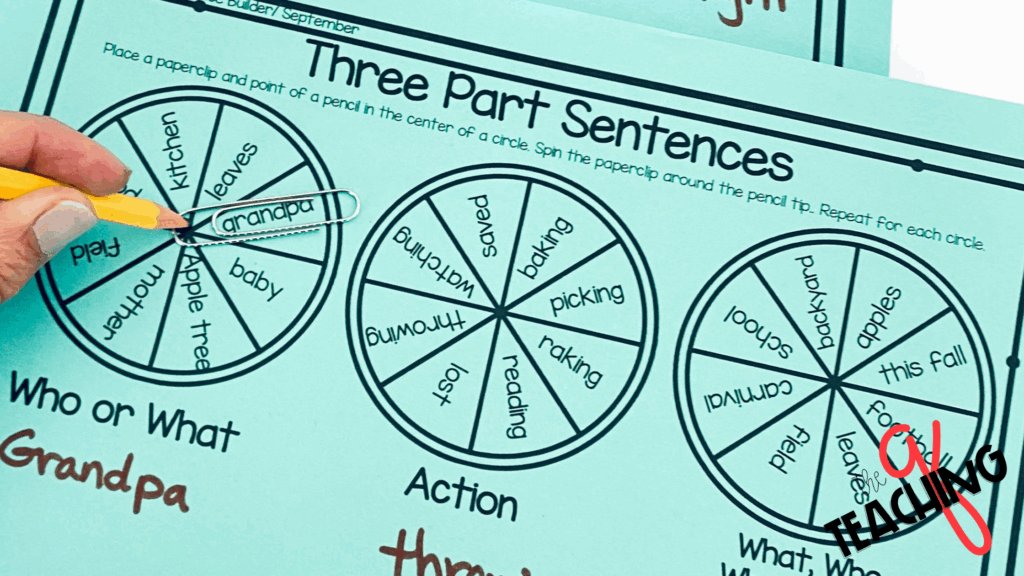 The spinner has three sections:
- Who or What – the subject (e.g., “The dog,” “Our teacher,” “The children”).
- Action- the verb (e.g., “is running, “baked,” “explored”).
- What/Who/Where/When – extra details to complete the thought (e.g., “in the park,” “a big cake,” “yesterday afternoon”).
Students spin each section, then put their parts together to make a complete sentence. Sometimes they get totally silly combinations, and that’s half the fun. Even the wackiest results help them see that every sentence needs someone or something, an action, and details that make sense.
To keep them thinking, I’ll challenge them to:
- Add adjectives or adverbs to spice it up.
- Rewrite the sentence to make more descriptive.
- Combine it with another sentence to form a compound sentence.
The beauty of both the strips and the spinner is that they make sentence structure visual, tactile, and interactive. Students aren’t just hearing about sentence parts, they’re building them, moving them, and playing with them until it clicks.
Step Three: Build a Consistent Sentence-Writing Routine That Students Can Depend On
If we only practice sentence writing once in a while, it won’t stick. Students need repetition and routine, not in a boring way, but in a steady, predictable rhythm they can rely on.
Here’s what it can look like in a classroom:
- Daily mini-practice – A quick warm-up where students fix a fragment or write a complete sentence from a prompt. Sometimes we’ll use cards from our subject–predicate match-up game or a seasonal mini-book page for an instant activity.
- Modeled writing – I write in front of them, talking through my thought process as I build a sentence. If we’re using the sentence spinner, I’ll model spinning each section, reading the parts out loud, and then writing the complete sentence.
- Sentence stems in early practice – For the first few weeks, I keep stems on the board or on a mini-anchor chart so no one is stuck wondering how to start. I might pair this with a themed sentence-building page so students can plug the stem into a fun topic.
- Sentence expansion challenges – We take a short, plain sentence (often one we built with the spinner or strips) and see how many details we can add while keeping it complete.
- Peer review – Students swap papers and check for missing parts using a quick checklist. They love being the “teacher” for a moment and often spot missing details or punctuation right away.
- The beauty of a routine is that it creates low-pressure practice. Kids aren’t afraid to make mistakes because sentence writing becomes an everyday part of class. Over time, you’ll notice them using stronger, more complete sentences in all their writing, even when it’s not the focus of the lesson.
Step Four: Keep Sentence Practice Fresh with Seasonal Themes and Ready-to-Use Activities
 Once students know what a complete sentence looks like, the goal is to keep practicing, without it feeling repetitive. That’s where seasonal and themed activities are a lifesaver.
Each month, I rotate in fresh topics so we might be writing about pumpkins in October, snow days in January, or field trips in May. The skill stays the same, but the subject matter changes just enough to make it fun again.
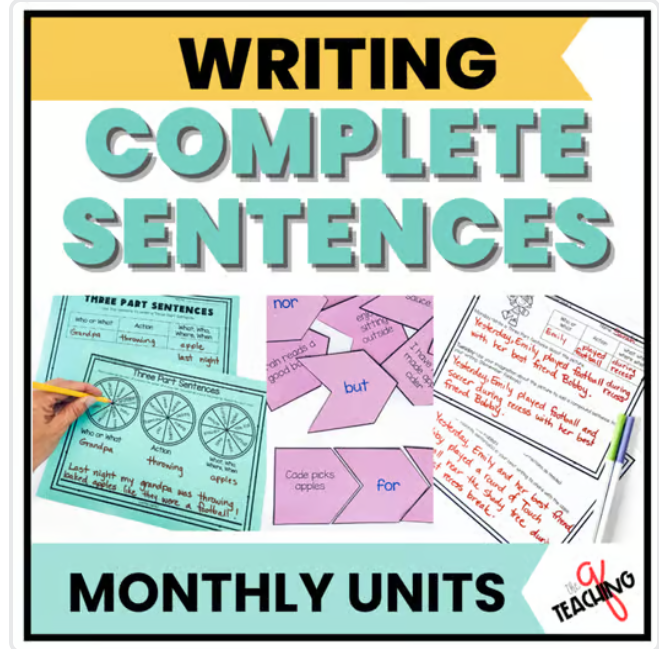
My Writing Complete Sentences Bundle is built around that exact idea. It includes:
-
- Monthly min-books from August through May
-
- Hands-on activities like subject-predicate match-ups, and the sentence spinner. puzzles, and adjective/adverb sorts
-
- Weekly sentence writing practice
-
- Printable worksheets and PDFs for easy prep
-
- Quick exit tickets so you can check understanding without adding grading overload
I use these in small groups, literacy centers, or as fast-finisher work. Because the structure stays the same, students know exactly what to do, but because the themes change, they stay interested.
And yes, sentence stems still come into play here. Even in seasonal activities, I’ll sprinkle in a few stems for students who need that extra support. It’s a simple way to make sure everyone feels successful, no matter their starting point.
At the end of the day, writing strong sentences is about building habits, providing clear structure, and giving kids the tools to express their thoughts with confidence.
So grab your coffee, pull out some engaging sentence activities, and watch your students grow from shaky sentence starters to confident, complete-sentence writers. Click the image below to grab the bundle! ⬇️
Want a ready-to-use activity you can try tomorrow?
I’ve put together a free mini-book from my Writing Complete Sentences Bundle so you can see exactly how I teach sentence structure in a fun, low-prep way.
Click here to grab your free Sentence Writing Mini Book and start building stronger sentences with your students right away!